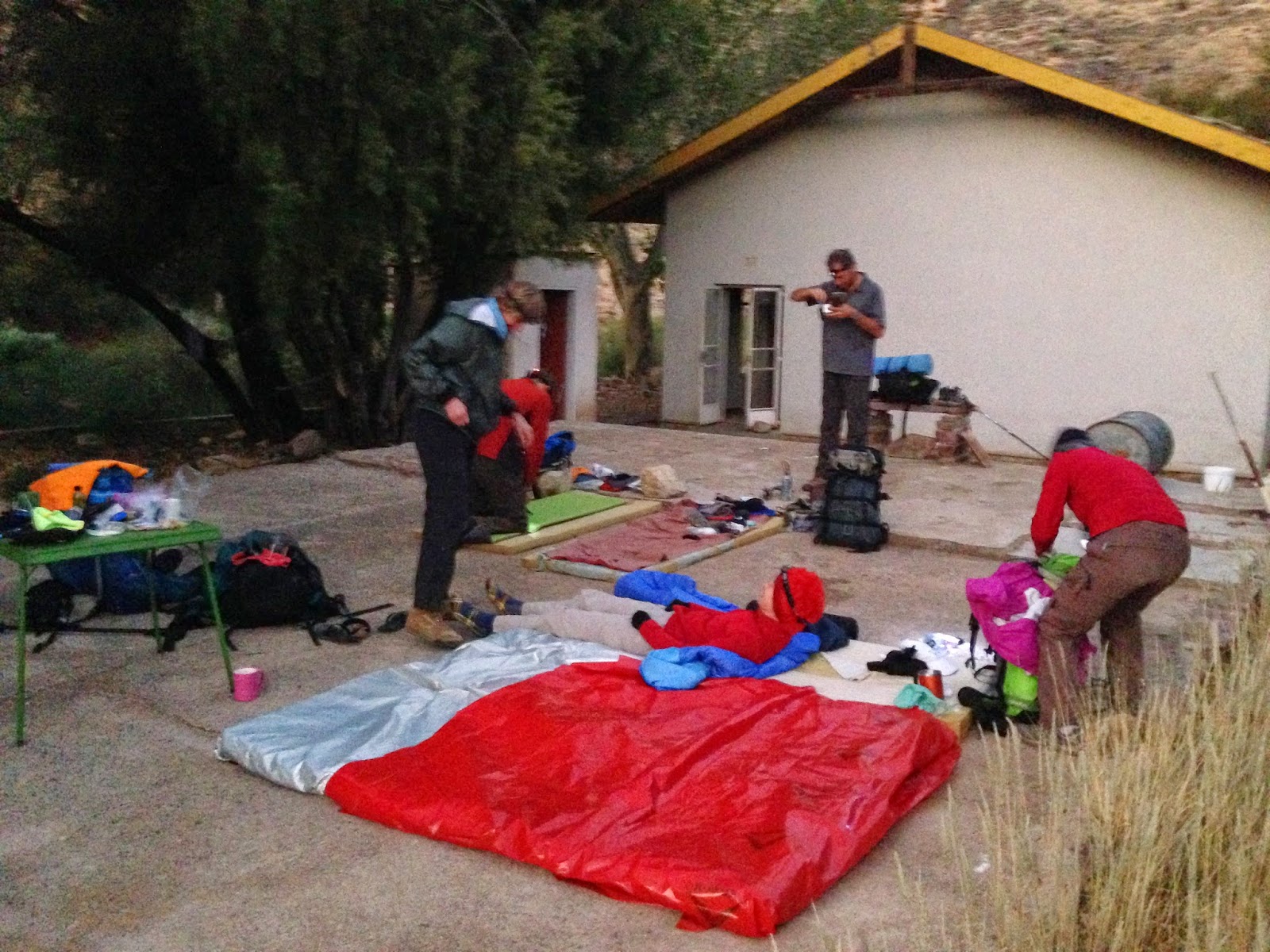
Ons klim stram-stram die volgende dag uit die tent en beskou die wêreld. Die blare van die populierbos lê so dik op die grond dat mens nie al die kamplekke kan uitmaak nie, maar daar kan nie meer as vier of vyf wees nie. Daar's nie veel hier om voor te talm nie en dis nog nie eers nege-uur toe ons weer in die pad val op pad Meiringspoort toe. Gevolgtrekking - El Yolo One dien sy doel as 'n oornagplek, maar nie veel meer nie.
Ons trek 'n paar keer af in die indrukwekkende en dramatiese Meiringspoort om skoene uit te trek en met ons voete in die yskoue bergstroomwater te sit. Dis ook uitstaande kiekie-wêreld dié, en ek spandeer heelwat tyd om fotos te neem en bietjie te eksperimenteer met my visooglens.
Toe ons deur die poort is debateer ons of ons by die Groenfontein grondpad gaan afdraai, en of ons gaan aanry en aansluit by die R62 tot waar die pad uitdraai na die Gamkaberg Natuurreservaat waar ons vanaand gaan oorstaan. Ons bel die selnommer vir Gamkaberg om te hoor hoe laat hulle toemaak, maar dit klink na 'n verkeerde nommer. So ons hou maar met die teerpad langs, versigtig vir laatkom na gisteraand se misrekening.
Dis net na drie-uur die middag toe ons voor die Gamkaberg Natuurreservaat se hek stop. Daar's niemand om vir ons oop te maak nie, en ons bel weer, met dieselfde gevolgtrekking. Gelukkig kom 'n bakkie aan van die ander kant af - die kampopsigter het ons stellig reeds lank sien aankom vanuit sy huis teen die berghang. Dit blyk dat ons die verkeerde nommer gebel het. Ons fout.
Die kampplek by Gamkaberg is goed ingerig en amper pynlik netjies. Daar is net twee kampplekke, en ons is die enigste inwoners vir vanaand. Elke kampplek het 'n sementblad vir tentopslaan, 'n afdakkie met twee gemakstoele en 'n lekker groot hout tafel. Net oorkant ons kampplek is 'n gerieflike gemeenskaplike braai-area, en ons besluit dis waar ons vanaand gaan kosmaak. Die ablusieblok is 'n ent se stap met 'n beligte voetpaadjie weg maar is skoon en modern. Die uitsig oor die omringende Karoo-berge uit die tent is voortreflik.
Dis 'n stil, wolklose aand. Nadat ons elkeen 'n smul lekker bord groentebredie uit ons bloedrooi driepootpotjie genuttig het, skakel ek al ligte in die kampplek af om 'n foto te neem van die Melkweg. Voor ek gaan inkruip sit ek 'n rukkie die heelal en beskou. Hoe bevoorreg is ons om die hemelruim so perfek te kan sien hier in die Kleinkaroo!
Die volgende oggend word ons vroeg gegroet deur 'n alomteenwoorde Janfrederik, 'n paar s
Spekvretertjies en 'n ongewoon mak Bokmakierie. Dis nog 'n vreugde van kamp - om elke oggend die kampeerterrein se voëls te ontmoet.
Ons staan twee aande oor hier, en besluit om vandag die grondpaaie waarvoor ons nie gister tyd gehad het nie te gaan verken. Ons ry deur skilderagtige valleie met vrugteboorde wat pryk in herfskleure van vele skakerings. Ons eet middagete by Kobus se Gat, 'n eetplekkie aan die voet van die Swartbergpas. Die pas het kort gelede verspoel, verneem ons, en is gesluit. Dis 'n jammerte, van dié pas is vir my een van die mees skilderagtige roetes in Suid Afrika. Ons draai half-bek-af om en ry stadig terug kampplek toe.
Showing posts with label africa. Show all posts
Thursday, June 1, 2017
Dag Drie: Gamkaberg Natuurreservaat
Labels:
4x4,
accommodation,
africa,
bundutop,
camping,
capenature,
gamkaberg,
kampeer,
kampeerterrein,
karoo,
off the beaten track,
outdoors,
south africa,
tourism
Thursday, December 29, 2016
The joys of hosting an AirBnB place
It's now just on two years that we have been on AirBnB, where we host the Aloe Cottage, our one bedroom garden apartment. At last count, visitors from 26 countries have stayed with us.
Now, let me say up front, running an AirBnB place is hard work.
That's if you're serious about it, which most AirBnB hosts aren't. A while ago we had to relocate a guest after we had an unexpected power outage. We contact five or six AirBnB hosts in the area, and only two bothered to reply, the one only two days later. In the end we booked them into a guest house, because we simply weren't sure of the quality we'd get at the available AirBnB places.
A few weeks ago Adeline spent a weekend in Cape Town and stayed at an AirBnB place. She should have known it was going to be less than ideal when most of the online reviews complained about the intermittent wi-fi. But she didn't expect to open the door one morning and see the host's husband prancing around in his boxers! The same host approached Adeline afterwards, asking for tips on how to improve her rating. Start by dressing your husband properly in the morning, and then invest in an uncapped ADSL line, Adeline said.
Spring cleaning the cottage after each guest, doing laundry, and being on point when they arrive - sometimes hours later than they said they'd pitch up - is hard work. To be sure, we spoil our guests, which adds to the chores. There's juice on arrival, flowers, a bottle of wine, a bowl of fruit and a jar of cookies, and that's only a partial list of extras. Recently guests of ours who were traveling the world asked about hairdressers and dentists, and we booked their appointments. We've run many guests to Gautrain station a few kilometers away, just to save them the Uber ride.
With the number of AirBnB places growing in double digits, you have to go the extra mile to be on top.
But the work that one has to put in is far outstripped by the sheer pleasure derived from seeing guests enjoying their stay. How do you know your guests are having fun? Here's a clue: If a young couple checks in after a long flight and don't show up for three days, you know they're happy :). If you see a guests sitting under a tree in the garden with a laptop, catching up on their blogging, you know they're content. I mean, they could also be sitting in a coffee shop, but they choose not to.
Here are a few of the things we find guests are most appreciative of, and will help ensure a glowing review after they've left.
- The one thing most guests mention is our garden. We don't have a large, expansive garden, but there are five water features, which I think are the things that attract attention.
- A well-equipped kitchen. It's really just a small nook with a plate stove, fridge and microwave, but we can see the utensils, pots and pans are well-used, especially by those staying for more than a few days. (Which is also why we went to Mr Price Home this weekend and replaced the worn utensils!)
- The informal lecture on what to see, where eat, and what to do. We have a full range of brochures, but find that the 'knowledge sharing' we do is much appreciated. We've even worked out a country-wide road trip for a German couple who wanted to tour SA.
- Reliable Internet. This is really a given, but nothing makes a guest turn nasty like dodgy or no Internet access.
- A largish table. We have a six seater table in the kitchen/dining room, and we see guests with their laptops all the time. Basically, they appreciate work space.
- Safe, off-street parking. Especially in Joburg!
- Flexible check-in. From experience we know how much it means when you arrive on a 6am flight in a foreign city with the knowledge that you can check into an AirBnB place straight away. We've had guests arrive at all hours, and seeing the relief on their faces when we open the door shows they appreciate that flexibility.
Now, let me say up front, running an AirBnB place is hard work.
That's if you're serious about it, which most AirBnB hosts aren't. A while ago we had to relocate a guest after we had an unexpected power outage. We contact five or six AirBnB hosts in the area, and only two bothered to reply, the one only two days later. In the end we booked them into a guest house, because we simply weren't sure of the quality we'd get at the available AirBnB places.
A few weeks ago Adeline spent a weekend in Cape Town and stayed at an AirBnB place. She should have known it was going to be less than ideal when most of the online reviews complained about the intermittent wi-fi. But she didn't expect to open the door one morning and see the host's husband prancing around in his boxers! The same host approached Adeline afterwards, asking for tips on how to improve her rating. Start by dressing your husband properly in the morning, and then invest in an uncapped ADSL line, Adeline said.
Spring cleaning the cottage after each guest, doing laundry, and being on point when they arrive - sometimes hours later than they said they'd pitch up - is hard work. To be sure, we spoil our guests, which adds to the chores. There's juice on arrival, flowers, a bottle of wine, a bowl of fruit and a jar of cookies, and that's only a partial list of extras. Recently guests of ours who were traveling the world asked about hairdressers and dentists, and we booked their appointments. We've run many guests to Gautrain station a few kilometers away, just to save them the Uber ride.
With the number of AirBnB places growing in double digits, you have to go the extra mile to be on top.
But the work that one has to put in is far outstripped by the sheer pleasure derived from seeing guests enjoying their stay. How do you know your guests are having fun? Here's a clue: If a young couple checks in after a long flight and don't show up for three days, you know they're happy :). If you see a guests sitting under a tree in the garden with a laptop, catching up on their blogging, you know they're content. I mean, they could also be sitting in a coffee shop, but they choose not to.
Here are a few of the things we find guests are most appreciative of, and will help ensure a glowing review after they've left.
- The one thing most guests mention is our garden. We don't have a large, expansive garden, but there are five water features, which I think are the things that attract attention.
- A well-equipped kitchen. It's really just a small nook with a plate stove, fridge and microwave, but we can see the utensils, pots and pans are well-used, especially by those staying for more than a few days. (Which is also why we went to Mr Price Home this weekend and replaced the worn utensils!)
- The informal lecture on what to see, where eat, and what to do. We have a full range of brochures, but find that the 'knowledge sharing' we do is much appreciated. We've even worked out a country-wide road trip for a German couple who wanted to tour SA.
- Reliable Internet. This is really a given, but nothing makes a guest turn nasty like dodgy or no Internet access.
- A largish table. We have a six seater table in the kitchen/dining room, and we see guests with their laptops all the time. Basically, they appreciate work space.
- Safe, off-street parking. Especially in Joburg!
- Flexible check-in. From experience we know how much it means when you arrive on a 6am flight in a foreign city with the knowledge that you can check into an AirBnB place straight away. We've had guests arrive at all hours, and seeing the relief on their faces when we open the door shows they appreciate that flexibility.
Labels:
accommodation,
africa,
airbnb,
johannesburg,
south africa
Saturday, April 11, 2015
Almost off the map in Botswana
We got really lucky a few weekends ago.
Friends of ours recently started work at a four star game lodge on the banks of the Limpopo on the Botswana side, and invited us to come and visit, for free. We didn't need much persuasion even though we weren't planning to go anywhere before setting off for Spain to walk the Camino, but hey, who can refuse a luxury long weekend in the bush, and mahala too?
I've never been to this corner of Botswana. And I mean that quite literally, referring to the notch where South Africa, Zimbabwe and Botswana meet, known commonly as the Tuli Block. It certainly hasn't been on my travel radar. I doubt whether anyone else but a handful of super-rich hunters and wild-life lovers show up here, and then I doubt even more whether the rich and famous venture out further than their game drive vehicles will take them.
We crossed into Botswana at the tiny Zanzibar border post, and ten minutes later we were all oohs and ahs about the lodge, which was all bespoke fittings and bush-veld chic. We relished every comfy moment in the massive bedroom with a five star view over the river and the outdoor shower that doubles as a bird watching spot, but having driven all this way we also wanted to explore the area. So after a good night's sleep we set off Saturday morning early on a 200km circular drive to explore the area. (Foreigners go on safari; South Africans take a drive).
The map we used as a guide promised several 'historical sites' and other attractions but there was no actual signage anywhere along the road pointing to them. 'Culture' here seems to be limited to the size of a warthog's teeth and a visitor's ability to tell the difference between a kudu and a waterbuck (all of which we spotted along the way). Which is a shame for a natural history junkie like me.
The dirt road we were on heading east became narrower and rougher as we continued until I was thankful that we were in the Landy and not our friend's hatchback. The landscape gradually changed from low, rocky hills to a broad river valley. Looking for clues of what lay ahead, Google maps showed that we would soon reach a bridge over the Matloutse river.
Well, to be fair, it showed we'd be crossing the Matloutse river, not how we'd be doing the crossing.
We round a sharp, forested bend in the road which then abruptly ended on a sandy bank of the Matloutse's dry riverbed that stretched out ahead of us for about 70 metres or so. On the opposite bank we could see a steep incline where the road - now little more than a washed-out track - continued. The river was a narrow, shallow stream that lazily snaked its way along the wide stretch of sand. A tall, imposing rock wall flanked the river on both edges, creating the impression that the river had at some point thousands of years ago broken through this natural barrier.
There was a strong, almost supernatural ambience here, almost like something from a Lara Croft movie, or a scene from one of those dinosaur hunting movies set in a steamy jungle. It felt like time immemorial has seen natural wonders wax and wane here, until, right now, it was a peaceful scene waiting to be discovered.
What was this incredibly beautiful, unmarked place, about?
It was only later, with the help of Wikipedia that we realised that we'd stumbled upon Solomon's Wall. The huge rock-faces with their ancient vines and the white roots (were these Namaqua fig trees?) spidering on it is called Solomon's Wall, and it once formed a dam behind which was a huge pre-historic lake. As we sauntered around the deep sand in the riverbed we each collected a handful of pretty, brightly coloured pebbles that are an alluvial leftover of the time the area was covered by the lake. There must've been a breathtakingly beautiful waterfall thundering over the wall before time, countless floods and the workings of nature eroded it, leaving the river to flow freely again.
And yet, no signage, no picnic spot, no explanatory notice board, nothing that says anything about what we saw. If not for the details preserved in Wikipedia we may as well be the first explorers to set foot here.
Well, almost. A trickle of 4x4 vehicles and intrepid mountain bikers showed up shortly before we left, just to prove that humanity has indeed reached into all hidden corners of the planet. But still, Solomon's Wall has the ambience of an ancient place where, given time to explore, one can probably dig up up a treasure trove of local legends and myths.
We had to make our way back to the lodge long before I was able to look around and take enough photos to satisfy my curiosity. So I plan to return as some point in the future, perhaps with one of my geologist friends to help lay out the rock history here.
Thinking about Solomon's Wall on the eight-hour journey back to Johannesburg reminded me of Mapungubwe, the site of an ancient civilisation that lay just across the Limpopo river in South Africa. Perhaps for them the lake was where giants and mythological beasts from that long gone era bathed before they were destroyed by a natural catastrophe, only living on in misty legends and fantastical fables.
The scientist in me laughs at that notion. But that's the magic of Africa - the stories it evokes through its amazingly beautiful natural history.
Friends of ours recently started work at a four star game lodge on the banks of the Limpopo on the Botswana side, and invited us to come and visit, for free. We didn't need much persuasion even though we weren't planning to go anywhere before setting off for Spain to walk the Camino, but hey, who can refuse a luxury long weekend in the bush, and mahala too?
I've never been to this corner of Botswana. And I mean that quite literally, referring to the notch where South Africa, Zimbabwe and Botswana meet, known commonly as the Tuli Block. It certainly hasn't been on my travel radar. I doubt whether anyone else but a handful of super-rich hunters and wild-life lovers show up here, and then I doubt even more whether the rich and famous venture out further than their game drive vehicles will take them.
We crossed into Botswana at the tiny Zanzibar border post, and ten minutes later we were all oohs and ahs about the lodge, which was all bespoke fittings and bush-veld chic. We relished every comfy moment in the massive bedroom with a five star view over the river and the outdoor shower that doubles as a bird watching spot, but having driven all this way we also wanted to explore the area. So after a good night's sleep we set off Saturday morning early on a 200km circular drive to explore the area. (Foreigners go on safari; South Africans take a drive).
The map we used as a guide promised several 'historical sites' and other attractions but there was no actual signage anywhere along the road pointing to them. 'Culture' here seems to be limited to the size of a warthog's teeth and a visitor's ability to tell the difference between a kudu and a waterbuck (all of which we spotted along the way). Which is a shame for a natural history junkie like me.
The dirt road we were on heading east became narrower and rougher as we continued until I was thankful that we were in the Landy and not our friend's hatchback. The landscape gradually changed from low, rocky hills to a broad river valley. Looking for clues of what lay ahead, Google maps showed that we would soon reach a bridge over the Matloutse river.
Well, to be fair, it showed we'd be crossing the Matloutse river, not how we'd be doing the crossing.
We round a sharp, forested bend in the road which then abruptly ended on a sandy bank of the Matloutse's dry riverbed that stretched out ahead of us for about 70 metres or so. On the opposite bank we could see a steep incline where the road - now little more than a washed-out track - continued. The river was a narrow, shallow stream that lazily snaked its way along the wide stretch of sand. A tall, imposing rock wall flanked the river on both edges, creating the impression that the river had at some point thousands of years ago broken through this natural barrier.
There was a strong, almost supernatural ambience here, almost like something from a Lara Croft movie, or a scene from one of those dinosaur hunting movies set in a steamy jungle. It felt like time immemorial has seen natural wonders wax and wane here, until, right now, it was a peaceful scene waiting to be discovered.
What was this incredibly beautiful, unmarked place, about?
It was only later, with the help of Wikipedia that we realised that we'd stumbled upon Solomon's Wall. The huge rock-faces with their ancient vines and the white roots (were these Namaqua fig trees?) spidering on it is called Solomon's Wall, and it once formed a dam behind which was a huge pre-historic lake. As we sauntered around the deep sand in the riverbed we each collected a handful of pretty, brightly coloured pebbles that are an alluvial leftover of the time the area was covered by the lake. There must've been a breathtakingly beautiful waterfall thundering over the wall before time, countless floods and the workings of nature eroded it, leaving the river to flow freely again.
And yet, no signage, no picnic spot, no explanatory notice board, nothing that says anything about what we saw. If not for the details preserved in Wikipedia we may as well be the first explorers to set foot here.
Well, almost. A trickle of 4x4 vehicles and intrepid mountain bikers showed up shortly before we left, just to prove that humanity has indeed reached into all hidden corners of the planet. But still, Solomon's Wall has the ambience of an ancient place where, given time to explore, one can probably dig up up a treasure trove of local legends and myths.
We had to make our way back to the lodge long before I was able to look around and take enough photos to satisfy my curiosity. So I plan to return as some point in the future, perhaps with one of my geologist friends to help lay out the rock history here.
Thinking about Solomon's Wall on the eight-hour journey back to Johannesburg reminded me of Mapungubwe, the site of an ancient civilisation that lay just across the Limpopo river in South Africa. Perhaps for them the lake was where giants and mythological beasts from that long gone era bathed before they were destroyed by a natural catastrophe, only living on in misty legends and fantastical fables.
The scientist in me laughs at that notion. But that's the magic of Africa - the stories it evokes through its amazingly beautiful natural history.
Labels:
4x4,
africa,
botswana,
off the beaten track,
solomon's wall,
tuli
Saturday, September 13, 2014
Naukluft Hiking Trail #10 - The last night
We woke up early on the morning of our second last day with everyone in a hurry to start walking. Normally we left the shelters in one group, but today everyone followed their own lead, and by the time Adeline and I saddled up we were the last to leave, the others having gone ahead. This had us speculating that the trail may just be a little too long, that six days rather than eight may be more ideal to prevent burnout and this sort of 'social disintegration' setting in. But that's idle speculation. The Naukluft is a solid eight days long whether you like it or not, and it's not getting shorter anytime soon.
We steadily gained height during the course of the morning until we reached a rock pile at the highest point of the trail. We were on top, so to speak!
Everyone knew from here on it was pretty much plain sailing and that the canyon slogging of the past few days had come to an end. So we enjoyed an extra long pause to have lunch and absorb the last amazing view of the outstretched valleys before we start on the final leg home. That would be plateau, and then a slow decline down to the starting point at Hiker's Haven.
The afternoon's walk was a long stretch crossing Kapokvlakte. After six days of mountains and deep valleys, we were now in a dramatically different landscape - a perfectly flat table top blanketed all the way to the horizon with kapokbosse - a dusty green shrub covered in pearl-sized, cotton-like balls that gave the plain its name.
Shallow indentations hinted at pans of water during summer, and here and here I spotted patches of mud and sludgy water with hundred of hoof indentations pockmarking the edges of the dark pools. Small herds of springbok broke the horizon now and again, the little ones playfully hopping and bouncing along.
Our final shelter, appropriately named Kapokvlakte, remained hidden behind a massive clump of bushes and trees until we were literally a few yards from it. Later, as we were preparing the last of the food in our bags for dinner, we were treated to the most spectacular bright orange sunset. Those who still had battery power left in their cameras scurried into the surrounding veld to capture this highlight of the trail. Having slept mostly at the bottoms of canyons the past few days, the sun would leave us quite surreptitiously and unnoticed every night, as it faded behind the mountains. Finally seeing the quintessential African sun set behind the horizon here on our final evening seemed like an appropriate goodbye from all of beautiful Naukluft.
By now temperatures had risen somewhat, and tonight wasn't as cold as it been at the outset. Or perhaps my skin had grown a layer or two of extra protection. I decided to for the first time ditch the thermal underwear that had kept me from freezing to death on previous nights, and slept soundly until 7am, two hours later than our normal rising time.
As we set out on the straight footpath leading home I turned a last time and looked at the last of the familiar stone shelters that had kept us, sort of, protected during the trail. Across the plain a few springboks were watching us walk away, curious about these strange animals that kept trekking through their territory.
We steadily gained height during the course of the morning until we reached a rock pile at the highest point of the trail. We were on top, so to speak!
Everyone knew from here on it was pretty much plain sailing and that the canyon slogging of the past few days had come to an end. So we enjoyed an extra long pause to have lunch and absorb the last amazing view of the outstretched valleys before we start on the final leg home. That would be plateau, and then a slow decline down to the starting point at Hiker's Haven.
The afternoon's walk was a long stretch crossing Kapokvlakte. After six days of mountains and deep valleys, we were now in a dramatically different landscape - a perfectly flat table top blanketed all the way to the horizon with kapokbosse - a dusty green shrub covered in pearl-sized, cotton-like balls that gave the plain its name.
Shallow indentations hinted at pans of water during summer, and here and here I spotted patches of mud and sludgy water with hundred of hoof indentations pockmarking the edges of the dark pools. Small herds of springbok broke the horizon now and again, the little ones playfully hopping and bouncing along.
Our final shelter, appropriately named Kapokvlakte, remained hidden behind a massive clump of bushes and trees until we were literally a few yards from it. Later, as we were preparing the last of the food in our bags for dinner, we were treated to the most spectacular bright orange sunset. Those who still had battery power left in their cameras scurried into the surrounding veld to capture this highlight of the trail. Having slept mostly at the bottoms of canyons the past few days, the sun would leave us quite surreptitiously and unnoticed every night, as it faded behind the mountains. Finally seeing the quintessential African sun set behind the horizon here on our final evening seemed like an appropriate goodbye from all of beautiful Naukluft.
By now temperatures had risen somewhat, and tonight wasn't as cold as it been at the outset. Or perhaps my skin had grown a layer or two of extra protection. I decided to for the first time ditch the thermal underwear that had kept me from freezing to death on previous nights, and slept soundly until 7am, two hours later than our normal rising time.
As we set out on the straight footpath leading home I turned a last time and looked at the last of the familiar stone shelters that had kept us, sort of, protected during the trail. Across the plain a few springboks were watching us walk away, curious about these strange animals that kept trekking through their territory.
Friday, September 12, 2014
Naukluft Hiking Trail 8 - Room with shower
And here we are, about to start day number five.
The path leading away from our overnight spot wound its by now familiar arid, rock-strewn way along hillsides and scenic canyons decorated with sparse clutches of spiky succulents and quiver trees.
Along the way we paused at a windmill hidden among a few dark green thorn trees. It was spinning wildly in the stiff breeze, yet the cement dam beside it was bone dry. All the man-made watering points we passed so far on the trail - mostly leftovers from the area's earlier farming days - were waterless, meaning it had been a lean summer that had recently turned into an early winter, which was where we were now in the seasonal cycle. It's a tough, unforgiving land, this Naukluft, and I silently admired the pioneers who first settled here many decades ago.
Today's trail was another solid 17km walk but after an hour or two of scaling a steep ridge the going levelled off, especially once we landed on a jeep track meandering its way along seemingly endless stretch of flat scrubland, carrying on for what felt like an eternity. The track eventually turned into a well-maintained dirt road leading into an impressive amphitheatre surrounded on three sides by towering cliffs several hundred metres high. One of the broadest cliffs visible in the distance was the imposing but bone dry Die Valle waterfall, which we had to scale tomorrow.
The first sign that indicated that tonight's stay-over was close by was a water tower with something that looked like a makeshift shower at its base. Wow! That would be a first. So far our bathing facilities have been limited to water from a two litre fold-up bucket, allowing for rinsing down only the most essential parts of our bodies. I was one of three lads who reached the tower first and it didn't take any convincing for us to dump our packs and before you can say "Lux beauty soap" we were splashing around under the gushing spout of water from an overhead pipe. We were soon reprimanded by the group laggards for wasting precious water but I think they were merely a little jealous having to wait for us to finish and emerge with broad smiles, soaked and refreshed.
The path leading away from our overnight spot wound its by now familiar arid, rock-strewn way along hillsides and scenic canyons decorated with sparse clutches of spiky succulents and quiver trees.
Along the way we paused at a windmill hidden among a few dark green thorn trees. It was spinning wildly in the stiff breeze, yet the cement dam beside it was bone dry. All the man-made watering points we passed so far on the trail - mostly leftovers from the area's earlier farming days - were waterless, meaning it had been a lean summer that had recently turned into an early winter, which was where we were now in the seasonal cycle. It's a tough, unforgiving land, this Naukluft, and I silently admired the pioneers who first settled here many decades ago.
Today's trail was another solid 17km walk but after an hour or two of scaling a steep ridge the going levelled off, especially once we landed on a jeep track meandering its way along seemingly endless stretch of flat scrubland, carrying on for what felt like an eternity. The track eventually turned into a well-maintained dirt road leading into an impressive amphitheatre surrounded on three sides by towering cliffs several hundred metres high. One of the broadest cliffs visible in the distance was the imposing but bone dry Die Valle waterfall, which we had to scale tomorrow.
The first sign that indicated that tonight's stay-over was close by was a water tower with something that looked like a makeshift shower at its base. Wow! That would be a first. So far our bathing facilities have been limited to water from a two litre fold-up bucket, allowing for rinsing down only the most essential parts of our bodies. I was one of three lads who reached the tower first and it didn't take any convincing for us to dump our packs and before you can say "Lux beauty soap" we were splashing around under the gushing spout of water from an overhead pipe. We were soon reprimanded by the group laggards for wasting precious water but I think they were merely a little jealous having to wait for us to finish and emerge with broad smiles, soaked and refreshed.
Wednesday, September 10, 2014
Naukluft Hiking Trail #6... Blisters
I left the camp, or rather the slab of concrete we called home the previous night still chewing frantically on a peanut bar, trying to get my energy levels up to a point where I'll be able to walk up the steep canyon for a few kilometers and scale a few chains inbetween. My normal, hearty breakfast consisting of coffee, a generous helping of Futurelife, and my blaster dosre of vitamin pills and energy sweets would have to wait until we reach the top of the canyon, 400 leg breaking meters above us, where we'd agreed to pause at a rock pool to eat and stock up our water supplies. I say 400m up, because the horizontal 14-17km we walked each day wasn't the issue, it was the daily slog of clambering in and out of canyons that took its toll.
On the way up we walked past the ubiquitous quiver trees flowering bright yellow bouquets, the first time I've ever seen them in bloom. Their flowers weren't unique; all along the drably coloured trail small splashes of colour decorated shrubs as if a giant artist spilled droplets of paint among the rocks and boulders that littered the way.
After about an hour of walking we reached the bottom of the first chain, the same one we'd used to descend into Ubisis Kloof the previous day. I felt a bit wobbly having had no meaningful sustenance but managed to heave myself and my kit up all of the chain sections, finally reaching a spot where, as usual, the fast walkers were already lighting their stoves and boiling water alongside a rock pool in the tiny stream that trickles along the base of the canyon.
Here's a tip on how to enjoy the Naukluft: Don't count kilometers. Day after day you'll be cris-crossing canyons that, if you're not careful, will feel like a never-ending rock-strewn eternity. Don't worry, they all do come to an end. And all have stunning landscapes that very few earthlings have ever visited and had the privilege to see. So make the most of your time there - stop often, enjoy the scenery, pause, be in the moment.
On most days the afternoon's hike is generally across flat plains, or runs down-hill. The designer of Naukluft, apart from being a chain fanatic, was also a master at understanding hike philosophy: Nothing breaks a hiker's spirit like a long uphill trudge climbat the end of the day when the hut is within sniffing distance. Here there are none of that, it's always a gentle roll up to the hut.
So it was a relatively easy walk across a few low rises to our next stop, Adelhorst Shelter. It was once again a roofed stone kraal, this time a round one with a hand crank water pump right next to it. By now stringing a washing line had sort of by default become my job at each stop-over, and within half an hour of it garments of all colours and shapes and sizes were fluttering in the wind.
It always strikes me how quickly daily rituals develop on hikes. One of the those on Naukluft was the regular pre-dinner plaster session, bandaging up the day's blisters. And blisters there were aplenty, and they multiplied as the days went on. Of the eight hikers only two were blister-less by the end, and I wasn't one of them. Boulder-hopping, rocky canyons and sheer distance took it's toll.
Fortunately one forward-looking hiker brought along zinc oxide plasters, which kept the pain and agony at bay. And most importantly, she brought enough along to keep a small army marching. I salute your foresight and sharing spirit, Comrade.
You can see all the pics from Naukluft in my Flickr gallery.
On the way up we walked past the ubiquitous quiver trees flowering bright yellow bouquets, the first time I've ever seen them in bloom. Their flowers weren't unique; all along the drably coloured trail small splashes of colour decorated shrubs as if a giant artist spilled droplets of paint among the rocks and boulders that littered the way.
After about an hour of walking we reached the bottom of the first chain, the same one we'd used to descend into Ubisis Kloof the previous day. I felt a bit wobbly having had no meaningful sustenance but managed to heave myself and my kit up all of the chain sections, finally reaching a spot where, as usual, the fast walkers were already lighting their stoves and boiling water alongside a rock pool in the tiny stream that trickles along the base of the canyon.
Here's a tip on how to enjoy the Naukluft: Don't count kilometers. Day after day you'll be cris-crossing canyons that, if you're not careful, will feel like a never-ending rock-strewn eternity. Don't worry, they all do come to an end. And all have stunning landscapes that very few earthlings have ever visited and had the privilege to see. So make the most of your time there - stop often, enjoy the scenery, pause, be in the moment.
On most days the afternoon's hike is generally across flat plains, or runs down-hill. The designer of Naukluft, apart from being a chain fanatic, was also a master at understanding hike philosophy: Nothing breaks a hiker's spirit like a long uphill trudge climbat the end of the day when the hut is within sniffing distance. Here there are none of that, it's always a gentle roll up to the hut.
So it was a relatively easy walk across a few low rises to our next stop, Adelhorst Shelter. It was once again a roofed stone kraal, this time a round one with a hand crank water pump right next to it. By now stringing a washing line had sort of by default become my job at each stop-over, and within half an hour of it garments of all colours and shapes and sizes were fluttering in the wind.
It always strikes me how quickly daily rituals develop on hikes. One of the those on Naukluft was the regular pre-dinner plaster session, bandaging up the day's blisters. And blisters there were aplenty, and they multiplied as the days went on. Of the eight hikers only two were blister-less by the end, and I wasn't one of them. Boulder-hopping, rocky canyons and sheer distance took it's toll.
Fortunately one forward-looking hiker brought along zinc oxide plasters, which kept the pain and agony at bay. And most importantly, she brought enough along to keep a small army marching. I salute your foresight and sharing spirit, Comrade.
You can see all the pics from Naukluft in my Flickr gallery.
Tuesday, September 9, 2014
Naukluft Hiking Trail #5: The Legendary Chains
All legendary hiking trails have quirky features and unique curved balls that, when they're talked about in general conversation, cause a tingle of apprehension, and raises the eyebrows of the uninitiated. Most of these mystical features can be distilled to one word, and in the case of the Naukluft that word is CHAINS. Note the multiple, it's intentional.
The guy (it would have been a guy) who developed the Naukluft route was probably a Marlboro Man type of character - tough, rugged, up for the challenge and convinced that everyone can keep up with his bundu bashing pace. So while on his treks to establish and lay out the route that would become the Naukluft Hiking Trail, he did on various occasions choose not to go around a natural obstacle but simple climb over it. Clearly his thinking was that future hikers, carrying their 15kg backpacks, would have no problem scaling 25m high dry waterfalls with nothing more than a pinch of courage and two bare hands. Fortunately sanity prevailed and he installed chain sections at the two dozen places en route where hikers have to climb over asteroid-sized boulders, shuffle precariously along canyon walls and find their way down cliffs that even the brave Naukluft dassies shy away from.
And here we were on the second day of the trail, staring down a rock face over which dangled a section of smoothly worn chain that was the gateway into Ubisis Kloof. Two members of our group were, fortunately for the amateurs among us, seasoned mountaineers who on several occasions saved the more clumsy among us from falling to our deaths, or at the very least helped keep the skin on our knees and elbows. They were already at the bottom of the kloof, merrily waving back to us and shouting encouragement. So one after the other the remaining six of us took hold of the chain and gingerly lowered ourselves, helped along by advice from below - a little to the left, a little to the right.... Almost there! I got down with no more damage than a scraped elbow and a finger pulled out of joint when it got tangled in a chain link at about halfway. As each hiker reached the bottom a cheer went up from those already there.
And so it continued during most remaining days on the Naukluft, up and down those legendary chains.
Are the chains really worthy of 'legendary'? I think so, yes. Many hikes have ladders, steps, and railings that make the trail easier. The Naukluft chains aren't there to make the going easier, they're obstacles in themselves, there to challenge you again, and again, and again. Well, that's the way it was for the majority of us who lost our climbing instincts at the age of seven, more or less at the time we discovered elevators and escalators.
But, back to the hike. Three days (that now feels like an eternity (ago) when we set off on this little junket, the Man Behind The Desk warned us, with a rather wilting apology, that the former holiday home we'd be staying over on the second day wasn't in as pristine condition as it may have been in its heyday, thirty years ago. Sure, the dilapidated four room building had bunk beds, a shower, and an outside toilet, but to cut a long story short we took one look at the filth that presented itself to us, and rolled out our sleeping bags under the stars on a slab of bare cement besides the erstwhile holiday house.
Most of us disappeared behind the bushes, spade in hand to do the necessary rather than utilise the doorless toilet, and apart from one or two hardened souls everyone skipped the shower and washed out of a plastic bucket. Thus, we ticked the third day off as having no accommodation.
And did I mention no water? About an hour after we arrived and started merrily washing up, filling water bottles and generally splashing around the one single outside tap that had water, it suddenly ran dry without warning. While everyone had a litre or two in their hydration packs to get by on, not having a water supply meant we'd have to skip breakfast and climb back up the chains into the top of the canyon where there were a few pools with drinkable water. This was a bad sign for me, since I'm a breakfast type of guy. I don't do mornings on an empty stomach well.
As always, the best workable attitude on the Naukluft also applied here: We'll wait and see how it goes.
You can see all the pics from Naukluft in my Flickr gallery.
The guy (it would have been a guy) who developed the Naukluft route was probably a Marlboro Man type of character - tough, rugged, up for the challenge and convinced that everyone can keep up with his bundu bashing pace. So while on his treks to establish and lay out the route that would become the Naukluft Hiking Trail, he did on various occasions choose not to go around a natural obstacle but simple climb over it. Clearly his thinking was that future hikers, carrying their 15kg backpacks, would have no problem scaling 25m high dry waterfalls with nothing more than a pinch of courage and two bare hands. Fortunately sanity prevailed and he installed chain sections at the two dozen places en route where hikers have to climb over asteroid-sized boulders, shuffle precariously along canyon walls and find their way down cliffs that even the brave Naukluft dassies shy away from.
And here we were on the second day of the trail, staring down a rock face over which dangled a section of smoothly worn chain that was the gateway into Ubisis Kloof. Two members of our group were, fortunately for the amateurs among us, seasoned mountaineers who on several occasions saved the more clumsy among us from falling to our deaths, or at the very least helped keep the skin on our knees and elbows. They were already at the bottom of the kloof, merrily waving back to us and shouting encouragement. So one after the other the remaining six of us took hold of the chain and gingerly lowered ourselves, helped along by advice from below - a little to the left, a little to the right.... Almost there! I got down with no more damage than a scraped elbow and a finger pulled out of joint when it got tangled in a chain link at about halfway. As each hiker reached the bottom a cheer went up from those already there.
And so it continued during most remaining days on the Naukluft, up and down those legendary chains.
Are the chains really worthy of 'legendary'? I think so, yes. Many hikes have ladders, steps, and railings that make the trail easier. The Naukluft chains aren't there to make the going easier, they're obstacles in themselves, there to challenge you again, and again, and again. Well, that's the way it was for the majority of us who lost our climbing instincts at the age of seven, more or less at the time we discovered elevators and escalators.
![]() |
| It doesn't look that high, but the base of the cliff is about 30m down. |
But, back to the hike. Three days (that now feels like an eternity (ago) when we set off on this little junket, the Man Behind The Desk warned us, with a rather wilting apology, that the former holiday home we'd be staying over on the second day wasn't in as pristine condition as it may have been in its heyday, thirty years ago. Sure, the dilapidated four room building had bunk beds, a shower, and an outside toilet, but to cut a long story short we took one look at the filth that presented itself to us, and rolled out our sleeping bags under the stars on a slab of bare cement besides the erstwhile holiday house.
Most of us disappeared behind the bushes, spade in hand to do the necessary rather than utilise the doorless toilet, and apart from one or two hardened souls everyone skipped the shower and washed out of a plastic bucket. Thus, we ticked the third day off as having no accommodation.
And did I mention no water? About an hour after we arrived and started merrily washing up, filling water bottles and generally splashing around the one single outside tap that had water, it suddenly ran dry without warning. While everyone had a litre or two in their hydration packs to get by on, not having a water supply meant we'd have to skip breakfast and climb back up the chains into the top of the canyon where there were a few pools with drinkable water. This was a bad sign for me, since I'm a breakfast type of guy. I don't do mornings on an empty stomach well.
As always, the best workable attitude on the Naukluft also applied here: We'll wait and see how it goes.
You can see all the pics from Naukluft in my Flickr gallery.
Thursday, September 4, 2014
Subscribe to:
Posts (Atom)